Why a leaf shipped from Brazil can do more good than a tomato grown down the road
A tomato grown fifty miles from your kitchen can be more exploitative than a leaf shipped from Brazil. It depends entirely on what happens between the field and your hand.
If that local tomato passes through six corporate intermediaries, a consolidator, a broker, a wholesaler, a distributor, a retailer’s buying arm, the store itself, most of what you paid disappears into the layers in between. The farmer who grew it sees a sliver. Meanwhile, a Brazilian leaf that moves through one short chain, direct from a small grower to the people who sell it to you, can return far more of your money to the person who actually did the work.
This is the part of “ethical sourcing” that almost nobody talks about. It’s not really about distance. It’s about the shape of the chain, how many hands your money passes through, and who gets paid at each stop.
Researchers call this a circular economy: a food system where value circulates back to the people who create it, instead of being extracted and concentrated at the top. And once you start seeing food this way, the whole conversation about where to spend your grocery money starts to look different.
What big agriculture leaves on the table
A 2022 systematic review published in Revista Vozes dos Vales synthesized 21 peer-reviewed studies on circular economy in agriculture. One of the most interesting findings was that circular food systems, where small producers, local knowledge, and regional economies all capture value instead of exporting it upward, tend to form around crops that industrial agriculture has ignored.
That’s not a coincidence. When a crop catches the attention of industrial agriculture, think soy, corn, palm, or more recently, açaí and quinoa, a predictable sequence unfolds. Big players move in. Production scales. Prices get squeezed. Small farmers are either absorbed into contract-growing arrangements or pushed out entirely. The crop becomes a commodity, and the commodity becomes someone else’s profit margin.
The plants that don’t get that treatment, the ones that grow in backyards, resist monoculture, feed families for generations, and never show up on a Chicago trading floor, quietly keep doing what food used to do. They nourish people. They support the communities that grow them. They exist outside the extraction.
What these crops have in common
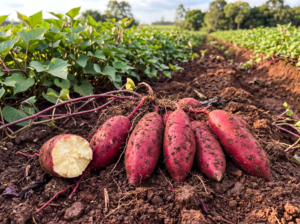
Think of the leafy greens, roots and tubers that families in Brazil, and in many other places, have grown in backyards for generations. Plants like these rarely end up in a monoculture plantation or on a futures exchange. Large agribusiness has little interest in them, which turns out to be exactly why they still work for the people who grow them.
They don’t rely heavily on inputs. Many grow in poor soil, need few or no pesticides, and don’t demand intensive irrigation. A small farmer can grow them without going into debt to buy seed, fertilizer or equipment from a multinational.
No one is squeezing the price at the farm gate. Without a commodity market setting an artificially low baseline, farmers can negotiate directly with buyers who want the actual crop, not speculators betting on it.
Small batch economics can still work. Moving food in small batches costs more per unit than shipping containers of industrial commodities. But when fewer middlemen take a cut, the extra margin doesn’t disappear. It can flow back to the farmers who grew it.
That’s what a circular economy actually looks like on the ground. It isn’t a slogan or a certification label. It’s a shape of supply chain where the people doing the work keep a meaningful share of the value.
Why extraction is the problem, not distance
Come back to that tomato and that leaf. What separates them isn’t mileage, it’s extraction. A modern food chain is, in practice, a sequence of tolls: each layer between the farmer and you takes a cut before passing things along. Not because anyone is ill-intentioned. It’s simply how the system was designed to work.
Every intermediary in a supply chain is a tax on the farmer and a markup on the buyer. Circular systems don’t eliminate trade, they eliminate extraction. The farmer gets paid. The buyer pays a fair price. The layers in between that used to absorb most of the value simply don’t exist.
The review found that publications on circular agriculture jumped sharply from 2019 onward, with Brazil among the top three countries driving the research. That’s not random. Countries with strong traditional food cultures are often the places where circular systems never fully collapsed, where the knowledge of how to grow outside the industrial model still exists.
What we can actually do
None of this means you have to overhaul your grocery list or feel guilty about what’s in your pantry. The industrial food system is what it is, and most people are navigating it on a budget, on limited time, feeding families with whatever makes sense that week. That’s not a moral failure. That’s life.
But when you do have the room to make a different choice, even occasionally, it helps to know what to look for:
- Crops that industrial agriculture ignores. If an ingredient isn’t a commodity, there’s usually more room for small farmers to actually get paid.
- Short supply chains. Fewer hands between the farm and you usually means more value stays with the people growing it.
- Companies that name their farmers, regions, or relationships. Vague “sourced globally” language usually hides a long chain.
- Crops that don’t need industrial inputs. If a farmer has to buy patented seeds or proprietary fertilizers to grow something, the real profit rarely stays with them.
The bigger picture
Eating well shouldn’t require a research paper. The fact that it increasingly does, that we have to investigate supply chains to figure out whether the food we’re buying is exploitative, is a symptom of a system that stopped being designed around the people at either end of it.
Supporting circular food systems isn’t a test of personal virtue. It’s a quiet vote for a different kind of system, one where the price of food reflects what it actually costs to grow, and where the people doing the growing get to keep a fair share of it. That’s not a lot to ask. It used to be the default.
Reference
Ferretto, L. R., & Lopes, R. C. (2022). O potencial de inovações a partir da implantação da economia circular no sistema agroindustrial [The potential for innovation through the implementation of the circular economy in the agro-industrial system]. Revista Vozes dos Vales, 11(21), 1-25. https://revistas.ufvjm.edu.br/vozes/article/view/1418