
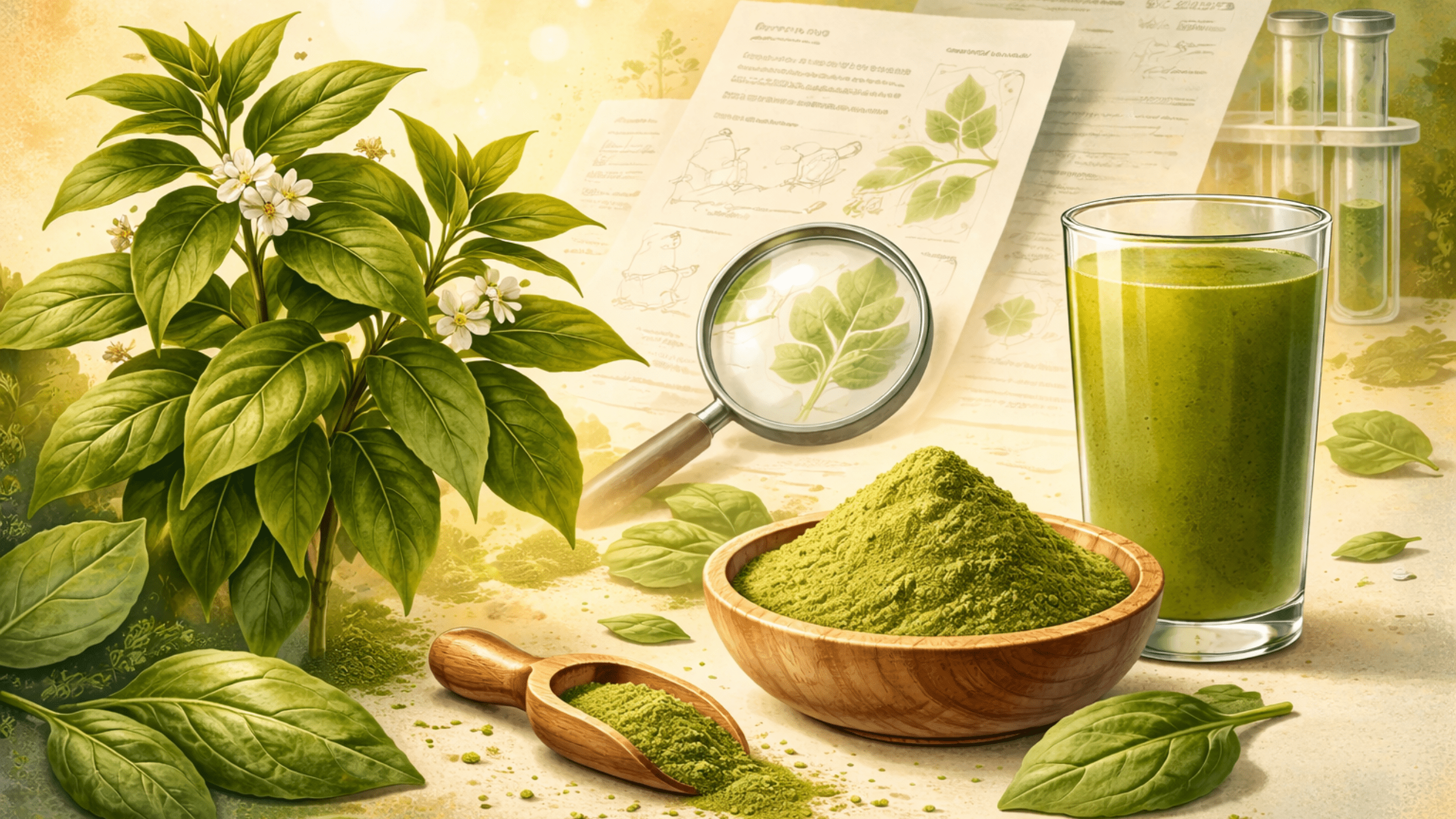
Separating Myth from Science
There’s a belief floating around social media and informal food discussions in Brazil that ora pro nobis leaves must be cooked before eating for them to be safe. This is understandable as many wild plants contain compounds that benefit from cooking, such as oxalates and tannins. However in the case of the species we use, that belief is not supported by science.
The confusion comes from mixing up different plant species with similar names, rather than from evidence showing raw consumption is unsafe. Let’s look at what the scientific literature actually says.
1. Ora pro nobis, aka Pereskia aculeata Miller, Is an Edible, Non-Toxic Plant With a Long History of Human Consumption
Pereskia aculeata Miller, the species used in our green powder, is widely documented as edible. Its fresh leaves are consumed directly in traditional diets, especially in parts of Brazil where it grows naturally and is known as ora-pro-nobis. Studies describe the non-succulent leaves as a traditional vegetable used in green juices, salads, omelets, pies, and stews, and also processed into leaf powder for breads and pastas, and other applications.1–5
Importantly, P. aculeata leaves are reported in peer-reviewed research as nutrient-rich and non-toxic. 6,7 On a dry-matter basis, 100 g of the leaves provides substantial amounts of protein, dietary fiber, vitamins A and C, and essential minerals. The plant has a long history of safe, traditional consumption- both fresh and dehydrated.
2. Scientific Toxicity Studies Confirm Safety
A controlled animal study evaluated the acute toxicity of P. aculeata extracts administered orally to laboratory rats at high doses. The researchers found no clinical signs of toxicity, no adverse effects on body weight or health, and no significant histopathological changes in multiple organs 6. This supports the conclusion that acute exposure is not harmful at levels far exceeding a typical dietary intake.
These kinds of toxicity studies are exactly how scientists screen for potential food safety risks. In this case, the results showed no observable toxic effects.
3. Raw Leaves Are Documented as Edible in Scientific and Food Resources
Scientific reviews and botanical databases list P. aculeata leaves as edible and nutritious, with raw consumption explicitly noted in many use contexts 1. The leaves contain a high protein content and are widely referenced as raw leafy greens in botanical and chemical databases 8,9.
In addition, P. aculeata is listed among “plantas alimentícias não convencionais” (PANCs), meaning non-conventional food plants in Brazil 4,10,11, which by definition are edible plants consumed traditionally, often raw or lightly prepared in local cuisines.
4. The Source of the Misconception: Species Mix-Up
Species confusion and visible botanical differences
The belief that ora pro nobis leaves must be cooked before consumption does not originate from toxicological evidence related to Pereskia aculeata Miller. Instead, it appears to arise from confusion between different species within the genus Pereskia that share similar common names but differ botanically, nutritionally, and in how extensively they have been studied.
Two species are most commonly confused:
Pereskia aculeata Miller
This is the species traditionally consumed as ora pro nobis and the one supported by scientific literature as edible and non-toxic 13.
Key identifying characteristics include:
- Smaller, thinner, succulent green leaves
- Leaves typically oval to lanceolate with a softer texture
- White to cream-colored flowers
- A climbing or sprawling growth habit
- Extensive documentation in ethnobotanical, nutritional, and food science literature
This species is the one referenced in studies describing raw consumption, inclusion in salads, and use in fresh or minimally processed preparations (Silva et al., 2018). In Brazil, Embrapa has even published a technical circular (official regulatory document) specifically on Pereskia aculeata Mill., detailing its cultivation in dense planting systems with successive harvest management, reinforcing its recognition as a studied, edible leafy vegetable suitable for fresh or processed use. 16.
Pereskia grandifolia
This is a different species, sometimes informally referred to by the same common name in certain regions, which contributes to confusion 14,15.
Key distinguishing characteristics include:
- Much larger, thicker leaves
- Leaves that are more rigid and leathery in appearance
- Distinctive purple to pink flowers
- Primarily ornamental use
- Far less studied as a food source
- Not listed as a vegetable in the Brazilian TACO (Tabela Brasileira de Composição de Alimentos)
Unlike P. aculeata, P. grandifolia does not have the same body of scientific evidence supporting routine dietary consumption, particularly in raw form.
Why this Distinction Matters
Scientific evidence supporting the safety and edibility of ora pro nobis applies specifically to Pereskia aculeata, not to all plants within the Pereskia genus. When recommendations about cooking or caution are made without specifying the species, they can incorrectly be generalized to P. aculeata, despite clear differences in botanical traits and research coverage.
This species-level confusion is common in discussions of non-conventional food plants (PANCs) and highlights the importance of accurate botanical identification when making food safety claims.
Bottom line: Pereskia aculeata Miller = ora pro nobis
Smaller leaves, white flowers, extensively studied, and edible raw or cooked. In Brazil, Embrapa has published a technical circular (official regulatory document) specifically on Pereskia aculeata Mill., detailing its cultivation in dense planting systems with successive harvest management, reinforcing its recognition as a studied, edible leafy vegetable suitable for fresh or processed use. 16.
5. A Common Follow-Up Question: What About Oxalates?
Oxalates are naturally occurring compounds found in many leafy vegetables. They are discussed in nutrition mainly because they can bind to calcium and, in susceptible individuals, contribute to calcium oxalate kidney stones. Importantly, oxalates are not toxins, and for most healthy people eating a balanced diet, they are not a safety concern.
Oxalate levels in ora pro nobis (Pereskia aculeata) have been directly measured in scientific studies. In one study evaluating ora pro nobis leaf flour, researchers reported an oxalate-to-calcium ratio of approximately 1.43, concluding that this level did not meaningfully impair calcium bioavailability2.
For comparison, studies of spinach (Spinacia oleracea) show that the amount of oxalate in the leaves exceeds the amount of calcium, leading to a high oxalate-to-calcium ratio, in one analysis, approximately 4.7 mEq oxalate per calcium equivalent, which explains why spinach calcium is considered poorly absorbed despite its high mineral content12.
Within this context, ora pro nobis falls in a moderate and nutritionally acceptable range, comparable to many leafy vegetables that are safely consumed raw.
6. Official Classification: Ora-Pro-Nobis in Brazil’s TACO Database
In Brazil, ora-pro-nobis is formally recognized as a food in the Tabela Brasileira de Composição de Alimentos (TACO), where Pereskia aculeata Mill. is listed under Vegetais e Derivados, including entries for raw leaves from multiple regions, confirming its official classification as an edible leafy vegetable 17.
Conclusion: Raw Ora Pro Nobis Leaves Are Safe to Eat
 Pereskia aculeata Miller is a non-toxic, edible plant species with fresh leaves consumed directly in traditional diets (e.g., salads, fresh preparations). Peer-reviewed toxicity studies show no adverse health effects, even at high exposures in animal models. It is widely documented as an edible leafy vegetable with rich nutrient content. Misconceptions arise from species confusion, not evidence of risk.
Cooking ora-pro-nobis is a culinary choice, often done for taste or texture, but it is not required to make the leaves safe to eat.
Sources:
- Silva, N. F. N., Silva, S. H., Baron, D., Neves, I. C. O. & Casanova, F. Pereskia aculeata Miller as a Novel Food Source: A Review. Foods 12, 2092 (2023).
- da Cruz, G. S. et al. Cereal bar enriched with ora-pro-nóbis (Pereskia aculeata Miller): physicochemical and sensory characterization. Journal of Food Science and Technology 61, 1547 (2024).
- Silva, D. L. G. et al. Nutritional Profile and Sensory Acceptance of Sourdough Breads Enriched With Ora‐pro‐nóbis Leaf Powder. Journal of Food Science 90, e70629 (2025).
- Takeiti, C. Y., Antonio, G. C., Motta, E. M. P., Collares-Queiroz, F. P. & Park, K. J. Nutritive evaluation of a non-conventional leafy vegetable (Pereskia aculeata Miller). International Journal of Food Sciences and Nutrition 148–160 (2009).
- da Silva Porto, F. G., Campos, Â. D., Carreño, N. L. V. & Garcia, I. T. S. leaves: properties and potentialities for the development of new products. Nat Prod Res 36, 4827–4838 (2022).
- Silva, D. O. et al. Acute Toxicity and Cytotoxicity of Pereskia aculeata, a Highly Nutritious Cactaceae Plant. J Med Food 20, 403–409 (2017).
- Phytochemical profile and biological activities of ‘Ora-pro-nobis’ leaves (Pereskia aculeata Miller), an underexploited superfood from the Brazilian Atlantic Forest. Food Chemistry 294, 302–308 (2019).
- [No title]. https://www.fcf.unicamp.br/wp-content/uploads/2023/11/Pereskia-aculetata-TCC-Monografia-Versao-final.pdf?utm_source=chatgpt.com.
- Pereskia aculeata. https://www.b4fn.org/resources/species-database/detail/pereskia-aculeata?utm_source=chatgpt.com.
- Agbede, T. Mineral nutrients and protein composition of non-conventional food plants (Pereskia aculeata Miller, Sonchus oleraceus L. and Xanthosoma sagittifolium (L.) Schott). Journal of Food Composition and Analysis 136, 106825 (2024).
- Sato, R. et al. Nutritional improvement of pasta with Pereskia aculeata Miller: a non-conventional edible vegetable. Food Sci. Technol 39, 28–34 (2019).
- Brogren, M. & Savage, G. P. Bioavailability of soluble oxalate from spinach eaten with and without milk products. Asia Pacific journal of clinical nutrition 12, (2003).
- Almeida, M. E. F. de & Corrêa, A. D. Utilização de cactáceas do gênero Pereskia na alimentação humana em um município de Minas Gerais. Cienc. Rural 42, 751–756 (2012).
- Teixeira, V. M. C. et al. A Critical Appraisal of the Most Recent Investigations on Ora-Pro-Nobis (Pereskia sp.): Economical, Botanical, Phytochemical, Nutritional, and Ethnopharmacological Aspects. Plants 12, 3874 (2023).
- Pereskia grandifolia – Plant Finder. https://www.missouribotanicalgarden.org/plantfinder/PlantFinderDetails.aspx?taxonid=369153.
- Cultivo de Ora-pro-nóbis (Pereskia) em plantio adensado sob manejo de colheitas sucessivas. – Portal Embrapa. https://www.embrapa.br/busca-de-publicacoes/-/publicacao/1066888/cultivo-de-ora-pro-nobis-pereskia-em-plantio-adensado-sob-manejo-de-colheitas-sucessivas.
- ..:: TBCA – Biodiversidade :: https://www.tbca.net.br/base-dados/biodiversidade.php.